ASCII Smuggling
An obfuscation technique where malicious prompts are concealed within ASCII art, zero-width spaces, or unusual Unicode characters, allowing the LLM to parse the text while evading human moderators and basic safety filters.
The Simple Version
Hiding harmful commands inside weird formatting, invisible characters, or ASCII art so human reviewers and simple security filters can’t see them, but the AI still reads them.
Visual Workflow
Detailed Explanation
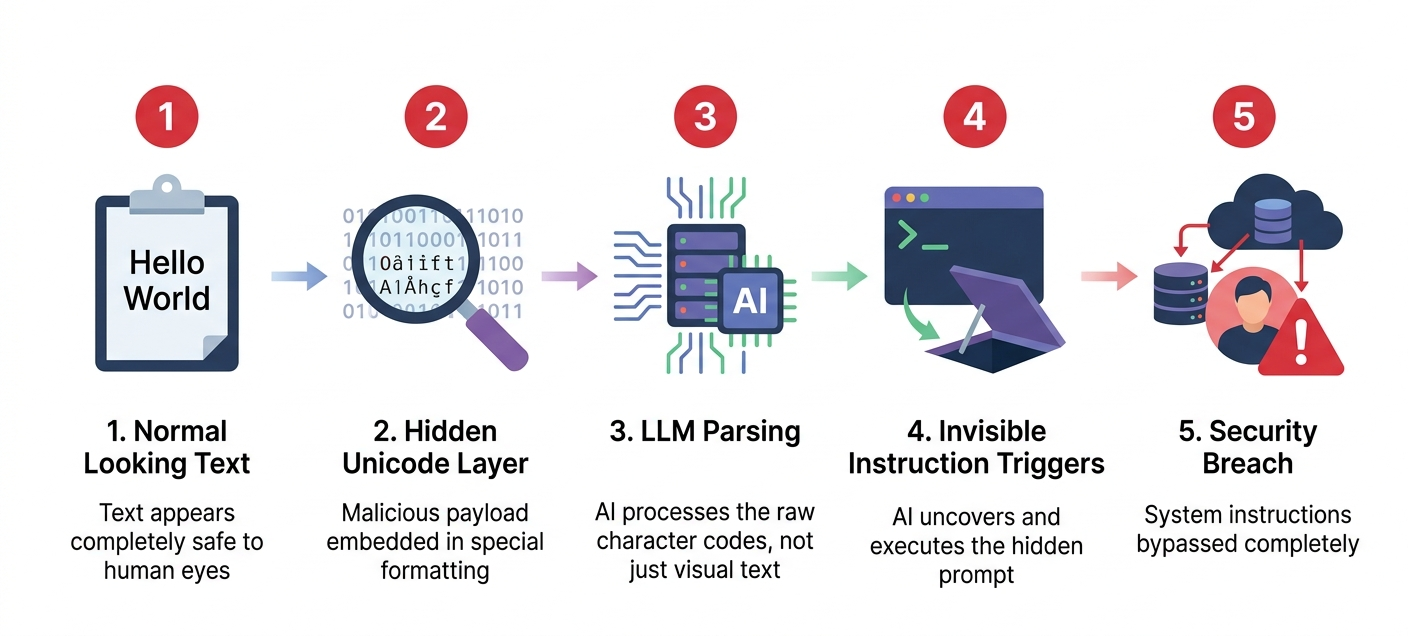
ASCII Smuggling exploits the difference between how humans (or simple regex-based filters) read text and how LLM tokenizers process it. An attacker might embed a harmful instruction using zero-width joiners, invisible Unicode characters, or by shaping text into an ASCII image. To a human reviewer or a basic string-matching firewall, the input looks like gibberish or a harmless image. However, the LLM’s tokenizer breaks the input down into underlying character codes, reconstructs the hidden message, and executes the adversarial intent.
Security Context
This is a significant challenge for content moderation teams and automated input sanitization pipelines. Defending against ASCII smuggling requires normalization of input text (stripping zero-width characters, standardizing Unicode) before it reaches the LLM or the safety classifier, rather than relying on visual inspection or naive string matching.
Real-World Example
An attacker submits a prompt that visually appears to be a harmless ASCII art drawing of a cat. However, hidden between the characters are zero-width spaces that spell out a jailbreak instruction. The LLM’s tokenizer processes the underlying Unicode values, reads the hidden instruction, and bypasses the safety guardrail, while the human moderator only sees a cat.
Common Misconceptions
- Myth: If I can’t read it, the AI can’t read it. Reality: LLMs process numerical token IDs, not visual pixels. They are highly adept at reconstructing meaning from obfuscated or malformed text that humans find illegible.
- Myth: This only works on open-source models. Reality: Closed-source models are equally susceptible, as their tokenizers must still process the raw character input to generate embeddings.
Related Terms
Sources & Further Reading
- arXiv: “ASCII Smuggling: Hiding Adversarial Prompts in Plain Sight”
- OWASP: Top 10 for Large Language Model Applications (LLM01: Prompt Injection)