Agent
An autonomous AI entity that combines a language model with the ability to perceive its environment, reason about goals, plan actions, use tools, and execute multi-step tasks with minimal human intervention — the fundamental building block of agentic AI systems.
The Simple Version
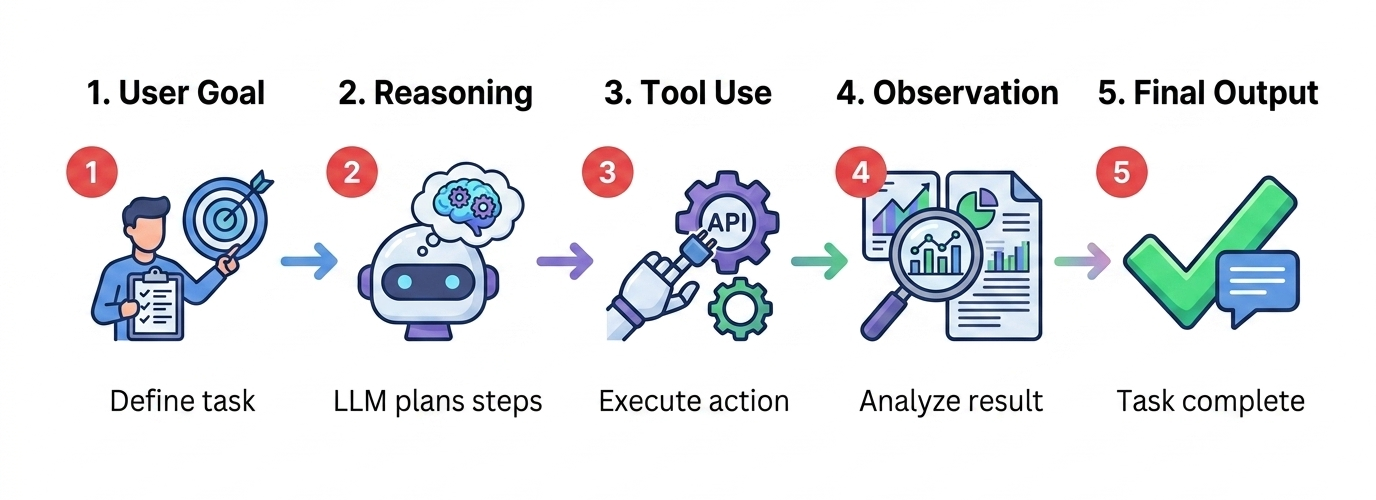
If an LLM is a very smart brain in a jar, an Agent is that brain given a body, hands, and a to-do list. It can look at its surroundings (perceive), think about what to do (reason), grab tools to accomplish tasks (act), and check whether it succeeded (evaluate).
A chatbot waits for you to ask a question and gives one answer. An Agent is given a goal (“Book me a flight to London under $1,000”) and figures out all the steps on its own: search flights, compare prices, check your calendar, book the best option, and add it to your itinerary.
Visual Workflow
Detailed Explanation
An Agent is the concrete instantiation of agentic AI principles. While “Agentic AI” describes the paradigm, an “Agent” is the actual system doing the work.
Core Components of an Agent:
- Brain (LLM): The reasoning engine that processes information and makes decisions
- Memory:
- Short-term: Current task context and conversation history
- Long-term: Persistent knowledge about the user, past tasks, and learned patterns
- Tools: External capabilities the agent can invoke (search, APIs, databases, code execution)
- Planning Module: Ability to break goals into subtasks and sequence actions
- Action Loop: Perceive → Think → Act → Observe → Repeat
Agent Architectures:
ReAct (Reasoning + Acting): The agent alternates between reasoning about what to do and taking actions.
Thought: I need to find the current stock price of AAPL
Action: search_web("AAPL stock price today")
Observation: AAPL is trading at $195.50
Thought: Now I can answer the user's question
Action: respond("AAPL is currently at $195.50")
Plan-and-Execute: The agent creates a complete plan upfront, then executes each step.
Plan:
1. Search for flights to London
2. Filter by price < $1000
3. Check user's calendar for availability
4. Book the best option
5. Add to calendar
Execute step 1... Execute step 2... etc.
Multi-Agent Systems: Multiple specialized agents collaborate on complex tasks.
- Researcher Agent: Gathers information
- Analyst Agent: Processes and interprets data
- Writer Agent: Drafts the final report
- Reviewer Agent: Checks quality and accuracy
Popular Agent Frameworks:
- LangGraph: Stateful, graph-based agent orchestration
- AutoGen: Multi-agent conversation framework
- CrewAI: Role-based agent teams
- OpenAI Agents SDK: Official agent building toolkit
- Anthropic’s Computer Use: Agents that can operate computers
Key Characteristics
- Autonomy: Operates with minimal human oversight once given a goal
- Goal-Oriented: Driven by outcomes, not just single-turn responses
- Tool-Using: Can invoke external APIs, databases, and services
- Iterative: Can loop, self-correct, and retry failed actions
- Stateful: Maintains context and memory across steps and time
Business Context
Agents represent the next evolution of enterprise AI, moving from “AI as a tool” to “AI as a worker”:
Enterprise Applications:
- Software Development: Agents that write code, run tests, debug, and submit PRs
- Customer Operations: Agents that handle entire support tickets end-to-end
- Data Analysis: Agents that query databases, analyze results, and generate reports
- Research: Agents that gather information, synthesize findings, and produce briefings
- IT Operations: Agents that monitor systems, diagnose issues, and execute fixes
Strategic Considerations:
- Human Oversight: Most production agents require human-in-the-loop approval for critical actions
- Security: Agents need strict permission boundaries — what can they access and modify?
- Cost Management: Multi-step agent workflows can consume significant tokens
- Reliability: Agents can get stuck in loops or make incorrect tool calls; robust error handling is essential
- Auditability: Every agent action should be logged for compliance and debugging
Agent vs. Chatbot: | Aspect | Chatbot | Agent | |——–|———|——-| | Interaction | Single turn or conversation | Multi-step task execution | | Control | User drives every step | Agent drives toward goal | | Tools | Limited or none | Multiple external tools | | Memory | Conversation context | Task + long-term memory | | Autonomy | Low | High |
Real-World Analogy
A personal assistant vs. a search engine. A search engine (chatbot) answers your questions. A personal assistant (agent) takes your goal (“Plan my vacation”) and handles everything: researches destinations, checks your budget, books flights and hotels, creates an itinerary, and sets reminders. You just approve the final plan.
Code Example
# Simple agent using OpenAI's Agents SDK (conceptual)
from agents import Agent, Runner, function_tool

# Define tools the agent can use
@function_tool
def search_flights(destination: str, max_price: int) -> str:
    """Search for flights under a given price."""
    # In reality, this would call a flight API
    return f"Found 3 flights to {destination} under ${max_price}"

@function_tool
def book_flight(flight_id: str) -> str:
    """Book a specific flight."""
    return f"Flight {flight_id} booked successfully"

# Create the agent
travel_agent = Agent(
    name="Travel Assistant",
    instructions="You help users book flights. Always confirm details before booking.",
    tools=[search_flights, book_flight]
)

# Run the agent with a goal
result = Runner.run_sync(
    travel_agent,
    "Book me a flight to Tokyo under $1500 for next month"
)

print("Agent completed task:", result.final_output)
# The agent will:
# 1. Search for flights to Tokyo under $1500
# 2. Present options to user
# 3. Wait for confirmation
# 4. Book the selected flight
# 5. Return confirmation
Common Misconceptions
- Myth: Agents are fully autonomous and don’t need humans.
-
Reality: Most production agents require human oversight, especially for actions that modify external systems (sending emails, making purchases, deleting data). “Human-in-the-loop” is critical for safety.
- Myth: Any LLM can be an agent.
-
Reality: While LLMs provide the reasoning, true agents require orchestration frameworks to manage state, tools, memory, and error handling. The LLM is just one component.
- Myth: Agents are just chatbots with more features.
-
Reality: The fundamental difference is the control loop. A chatbot waits for the user. An agent actively drives the process forward to achieve a goal.
- Myth: Agents always work perfectly on the first try.
- Reality: Agents frequently need multiple iterations, self-correction, and human intervention. Robust error handling and retry logic are essential for production use.